Ask an owner in Varna to put 15 percent on next month’s quotes and watch what happens to the conversation. It stops being about money and starts being about loyalty. They have known these customers for nine years. The man with the bakery sends them business. It would feel like a betrayal.
Nobody has that reaction to spending another 400 euros a month on Google Ads, which is strange, because the ad spend is the move that definitely costs something.
The fear, stated properly
The fear is that customers will leave. Some will. The part owners almost never work out is how many they can afford to lose and still be ahead.
That is arithmetic, and it takes about ten minutes with your own figures. Take your gross margin. Work out the revenue you would have to keep, at the new price, to match today’s gross profit. On thin margins a modest rise can absorb a surprising amount of churn and still leave you with the same profit and less work. On fat margins the rise barely needs to hold anyone. Either way you end up with a number you can defend rather than a feeling you cannot.
Then there is the second fear, that price is the reason customers chose you. Among the small businesses whose numbers we have gone through, it usually was not. They chose availability, proximity, the fact that somebody answered the phone on a Saturday. Price is what customers name afterwards, because it is the easy thing to say out loud.
Signs you are already underpriced
- You win almost every quote you send. A very high win rate is not a strong sales process. It is a price below what the market would bear.
- Nobody ever pushes back on the number.
- You are busy and still not making money.
- Your price is last year’s price plus a bit, rather than anything to do with what the work is worth now.
- You resent your worst clients. That is usually a pricing problem wearing a personality costume.
Three or more and you are funding your customers out of your own margin.
The mechanics, which matter more than the size
Start with new customers only. Change the number on the next quote you send, with no announcement and no explanation, and watch the win rate for four to six weeks. That is real market data at almost no risk.
Change what is included at the same time. A rise attached to a visible change in scope reads as a new offer. A bare rise on the identical thing reads as a grab, which is what it is.
Move existing customers in tiers. Take the least profitable third first, give notice in writing with a date, and accept that some will go. Those are generally the accounts eating the capacity you need for the rest.
Give one sentence of reason and then stop talking. Costs, demand, scope. Owners lose the increase by over-explaining and opening a negotiation nobody had asked for. And write down your floor before the conversation, because without it the first firm objection will set your price for you.
Hermann Simon spent four decades on this and filled a book with it, Confessions of the Pricing Man (Springer, 2015). His complaint about managers is not that they price badly in some technical sense. It is that they treat price as a given and volume as the variable, when the leverage runs the other way.
Here is the number
You are probably still half-resisting, so here is the thing that should settle it. McKinsey’s Michael Marn, Eric Roegner and Craig Zawada ran the sensitivity analysis across the S&P 1500 for The Power of Pricing: for the average company in that index, a 1 percent price rise with volumes held flat produces an 8 percent increase in operating profit. Nearly 50 percent more than a 1 percent cut in variable costs. More than three times the effect of a 1 percent lift in volume. They went on to write The Price Advantage (Wiley) off the back of it.
One percent. The increase you would be embarrassed to even call an increase. Meanwhile everything you have been doing instead, the extra budget and the new landing page and the Saturday shifts, is buying you volume, the weakest of the three levers.
Holding price is not standing still
Bulgarian wages rose 9.8 percent year on year, putting the average gross monthly wage at 1,444 euros in the second quarter of 2026. Headline inflation over the same stretch was nowhere near that: 3.3 percent in the year to February 2026, with the twelve-month average for March 2025 to February 2026 at 4.5 percent. If you set your prices off the inflation figure in the news, you are indexing to the wrong thing. Your largest cost is people, and people got nearly 10 percent more expensive.
So a static price list is not neutral. It is a decline you cannot see on the top line, because revenue looks flat while the cost of producing it climbs. The same thing happens on the acquisition side: competition in paid auctions increases, inventory does not.
Where the margin should go
This is where increases get wasted. The money arrives, merges into cash flow, and six months later nothing has changed except that you are slightly less anxious on the 25th.
- Buy back your own time. Hire out or outsource the task you are worst at and least willing to do.
- Fund acquisition properly. In any auction-based channel, the business that can pay the most per customer and stay profitable eventually takes the inventory. Margin is ammunition.
- Improve delivery for the people who just paid more.
If you want to know what your margin can actually support in a paid channel, that is the arithmetic we walk through in a consultation, and it is the same arithmetic behind what a customer really costs you to acquire.
Raise it on the next three quotes. Not a token two percent. If you win all three, you were further under than you thought. If you win none, you have bought that information cheaply. Do it while you are busy, because the owners who wait end up doing it in a crisis, which is the worst moment to ask anyone for money.
 Business Club Varna2 years, 140+ members, zero ad spend
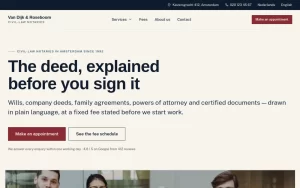 Van Dijk & RoseboomPublished fees, Dutch and English as equals
 Construction Elite RoofingCost per booked job cut by 41%
 Mascot MilleniumBuyers from 12 countries in year one
 Solene EstatesLive filtering across sale and rental
 Ignite Art UniversityFiltered course finder, ten degrees
 Marchetti Italian FurnitureSeparate catalogue and bespoke paths
 KUKUIPart of the team managing $8M+ a year